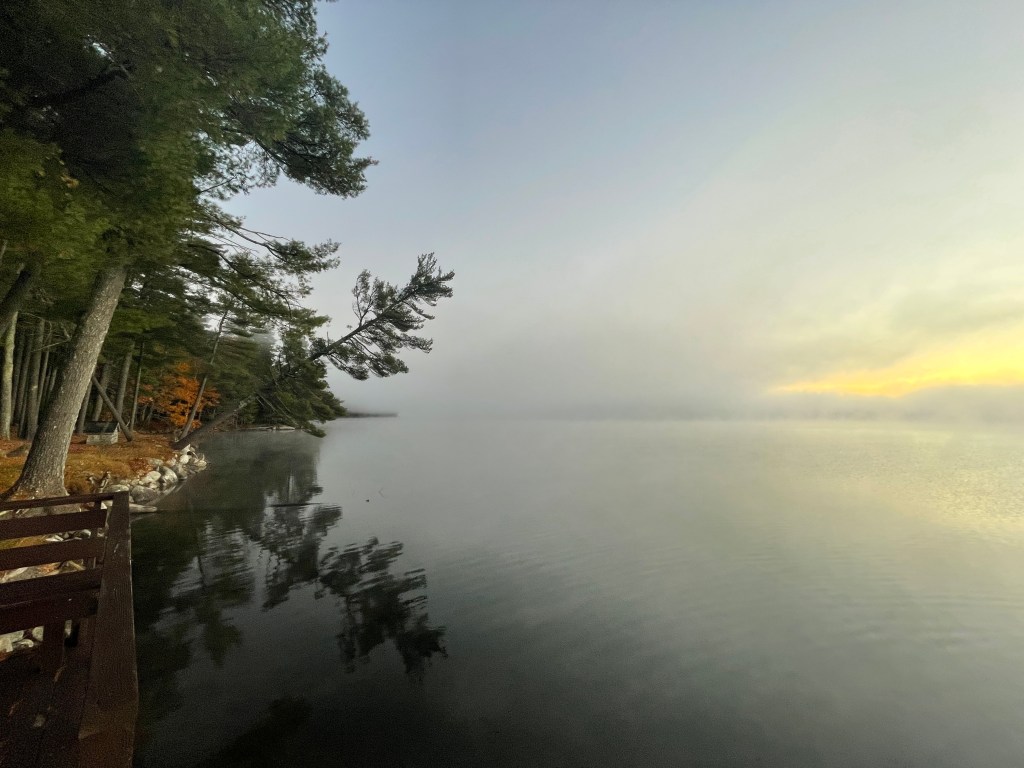
When I woke up on the morning of the first big snow storm this season, I went to the picture window and looked out at the lake. There’s a tree rooted in the shoreline that leans out over the water, and everyone who visits wonders when it’s going to fall in. I see the tree every day, so I don’t register its decline as much as those who see it once or twice a year. “Wow, that tree is going to fall in!” It’s not something I have enjoyed talking about. I’d rather think that this healthy tree just grows that way, not that the ground it’s rooted in is too crumbly to support it. “Yeah, it could happen, but it’s been like that for so long, so who knows?”
I stand in the in the window and contemplate the tree. Heavy snow is piling up on it — not enough to matter, I think it’ll be fine — and I try to picture the shoreline without it there. Would it look bald or like it had never even been there? We commune. Then I walk away and crawl back under the covers with my coffee. Had I lingered a moment longer, I would have seen it fall in.
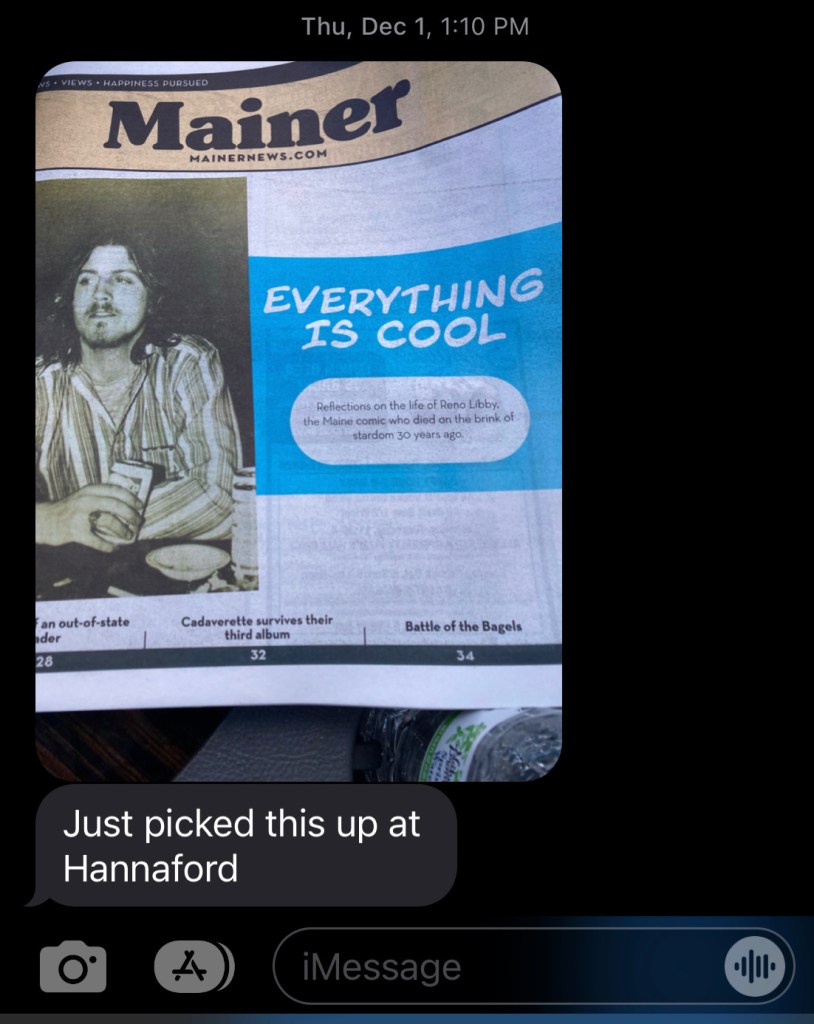
Yesterday, a friend texted me the cover of the recent issue of Mainer because there is a picture of Reno on it. They had written an article about him: “Everything Is Cool: Reflections on the life of Reno Libby, the Maine comic who died on the brink of stardom 30 years ago.” Reno was my boyfriend in those days, and then my friend. I texted my friend back that I didn’t think I could read the article, yet.
We met at a dive in the Old Port called Amigos, where he played pool. He was the best in town. (Years after he died I was playing pool and realized in a flash that he had taught me to hold the pool cue wrong, on purpose.) We made eyes at each other for a few nights, and were together from the moment he stopped by my table to ask if I wanted to be his partner at pool. I said, “I suck.” He said, “All right. But that’s not what I asked you.”
At last call, he asked to take me to dinner the next day. Just a sweetness, no barfly banter. His roomie and mine horned in on our plan and both insisted on joining us. His had a crush on mine, and mine wanted a free meal. So the four of us met up somewhere with hard plasticky booths and fluorescent lighting, maybe Chinese, and Reno told stories over dinner that made me laugh till I was helpless, mascara everywhere.
It was surreal to see him standing there in my living room, that first full day we spent together, when I still wasn’t situated with what he looked like in the sunlight. He seemed a little feral and I was a little dazed. But integration was swift. I was all in. We went to his place and picked up his dog, Duke, dorked around town, showed back up at Amigos together. I got used to the smokey smell of his beard. He moved in.
At the end of things, he had started spending a lot of time away from home, just getting lost. I didn’t know where he was going. I hated finding him passed out in the living room, soaking in spilled beer. I remember standing over him holding my breath, waiting for him to breath because I wasn’t sure he would. He’d take my car and stay gone till I was frantic. And lonely. If he was doing heroin then, I wouldn’t have been able to interpret what I was seeing. He didn’t bring it home. One night after he had been MIA, I asked him if he’d give up our relationship to keep partying like a maniac. He said, yes, he guessed he would. I reacted like a twin maniac, sweeping all the clutter off our dresser onto the floor. I’d asked a question I truly didn’t want the answer to, and there was no equivocation in that answer.
The hard, shitty information he gave me that night lightened things up around the house, though. It wasn’t my place to tell him anything, anymore. We continued to live together and our breakup was lingering and a little messy, but never contentious. I remember that Ren and Stimpy had come out around then, and we’d watch it together, leaning into each other laughing, even as we disentangled. We eventually moved out of the place we shared. I went to Old Orchard. He still called me. He called to tell me when he won the Tonight Show thing.
When Reno died, I was visiting my mother in Florida for the holidays. While I was there, my dad called me from Maine to tell me that Reno’s mom had been calling his office. When he finally connected with her, she was so hysterical he couldn’t make out what she was telling him, but it sounded to him like Reno’s father had died. And why wouldn’t she call my father about it? She had to be beside herself. My dad’s a lawyer, and maybe she needed help with something. (I realize that she was trying to reach me.) I didn’t question my father’s interpretation. I never wondered if it could have been Reno who died. There wasn’t a whisper of that possibility in my mind to reject. I didn’t know what he was doing.
When I returned from Florida after the new year, I went straight from the airport to a restaurant in the Old Port where my friend, Johnny, was working. Johnny came out of the kitchen to greet me and immediately asked if I had heard about Reno. I remember that inner drop, the feeling of my equilibrium shifting at the odd question because… why would Johnny know about Reno’s dad? I said, “Yeah, his dad died.”
Johnny said, “Ilse… No.”
Reno’s funeral was already over by the time I found out. There was nothing left of him, like he evaporated. Nowhere for me to go with it. I wasn’t his girlfriend anymore, so no one cared that I’d lost him. It wasn’t my place to freak out or grieve publicly. His little brother came to visit me a few times, though. He’d show up, fully shattered, sit next to me on my futon, bereft and half mad with grief.
A couple of years later, I went half mad myself. I was living alone, in another state, and found myself unmoored by this grief and heartbreak that I didn’t feel a right to. Maybe being alone and far away made the space for it, and the sudden, stupefying weight of it rolled in like a sneaker wave. I even sought out a psychic, which I knew was so dumb, but I would have rather been told a lie than keep spinning out there with nothing. The psychic told me that Reno was around, but he was busy singing. I mean, it sounds right.
These days, I hold space with people who are walking with grief. When I’m in it myself, I am as messy and heartbroken as anyone, though it helps to have words for what I’m experiencing. It doesn’t hurt less, but having the language allows me to name and hold my own grief with compassion. I recognize now that I was navigating “disenfranchised grief” — a loss that leaves the bereaved feeling their suffering is illegitimate, invalid, or overblown. Often, it’s a grief that’s denied mourning, the embrace of community. No one wonders if you’re OK.
Seeing Reno’s picture on my phone yesterday swung open a door that let a ragged grief slip in around my chest. I remembered that old picture, taken before I knew him. When I saw his face and the title of the article, I felt the estrangement fresh again, and added 30 years distance. I raised a whole child into a grown up with a full time job in that time. But here I am, aching just the same, and still on the outside looking in. No one remembered I was there. That I was the girlfriend in the jokes he told those first open mic nights. No one knows he was here, sleeping beside me in this room on the lake where I’m writing this.
No one looked me up to ask if he’d crinkle his nose and look straight into your eyes when he laughed, because he only ever laughed with you. Does anyone remember his Zigzag man tattoo and those gross, flappy, beat up red shoes he thought were his dress shoes (it was wrong of me to hide them). How he carried Visine everywhere, not because he was stoned (he was), but because he had burned his eyes on the snow, skiing without sunglasses, and they wouldn’t tear up anymore. How he’d astral project, and tell me things he should not have known unless he had somehow been there.
One night, he went to bed before me while I stayed up late catching up with a friend who was visiting from out of state (actually, my roomie from that first date, who had since moved on). She and I took a boozy, midnight walk around the neighborhood, stopping to sit on the steps of a nearby church. When I crawled into bed next to Reno later, he woke up and told me all about my walk, about everything my friend and I talked about, about the church steps. He said he hadn’t meant to, but popped out of his body as he was falling asleep and followed me. He seemed to keep one foot in that unknowable plane and told me how he’d talk to his dead friends there. I knew he wasn’t entirely earthbound.
Does anyone know that when he was a little kid, he was celebrated in the paper for being the only one in town to figure out that the loud, mysterious plague that descended on Waterville was a swarm of newly hatched 17 year cicadas. His mom showed me the newspaper article while we perused Libby family photo albums on her coffee table. Maybe that’s when I first saw the picture that appears on the Mainer cover.
I wonder if anyone else remembers that he idolized Sam Cooke and Harry Chapin along with John Prine? A pantheon of storytellers that should include him. He should be there. Can anyone else still hear Reno telling Duke to “Stay close.” I say that to my dogs, now, too, and think of Reno every single time it comes out of my mouth. They don’t know what it means.
When theMainer article finally appeared online, I could only squint at it at first. It was a bit like looking straight at the sun. I opened and closed it a few times, absorbing it in bits and pieces. One of those times, I alighted on a detail that shifted my footing and the entire landscape in a blink. I had been outside; now I was inside, but the effect was the opposite of disorienting. It was integrating: Reno had a copy of A Prayer for Owen Meany on his table when he died. Reno’s brother, Michael, remembers that Reno picked it up after someone had mentioned it to him at a party. I believe it, but there’s more. When Reno and I were together, John Irving was in my personal pantheon of storytellers. I was particularly smitten with Owen Meany. Reno knew. I shared Irving with him the way he shared John Prine with me. Learning he had this book with him when he died is like seeing a star twinkle into focus in a black sky, being touched by a light that took 30 years to reach me.
The first thing to go was cigarettes. I think if I had been a heavy smoker, it would have been easier. I’d have stopped sooner because it would have been obvious and urgent. I justified it because I was one of those infuriating situational smokers. You weren’t going to find me standing out in the snow to get a fix. I think the last cigarette I smoked was with my step-sister on the patio of my step-dad’s apartment the day after he died. Before that one, I’m not sure — weeks or months. Still, I had been doing it since I was in high school. It was delusional and disgusting, and I hated everything about it (except actually doing it), but, sure, I wasn’t a smoker-smoker.
Here are a few more things that I’ve opted out of: coloring my gray hair, alcohol, animal products, cable news, and boyfriends. Each of these lettings-go was inevitable — like molting. They just don’t make sense for me. They don’t contribute. They don’t align. They require an effort of cognitive dissonance that I can’t maintain. I reached a tipping point with each of these things, and there are still more teetering on the edge (like a sticky doom-scrolling habit, for one).
After grasping at them for so long — some more tightly than others — I’m amazed how almost effortless it was to drop them, like brushing a crumb off my shirt. As easy as it was initially, I will get some panicky aftershocks: “Oh shit, what did you do? Pizza is over!” And for a minute I’ll scramble to figure out if I can save pizza, but I can’t. It really is over.
The more lifestyle detritus I shed and the more aligned I become with my values, the more space and time open up. It also becomes immediately clear that honoring this freedom requires a strength and skill that have atrophied from distraction. I’m starting to see a blank canvas that’s always been right here in front of me, and grieving time lost now that I’ve noticed it. The challenge now is to learn to engage it with intention and creativity. It’s like the post-pink-cloud phase of overcoming an addiction, when you realize you can’t build a life around just not doing a thing. You have do something now.
The great opting-out is ongoing, and I’m carefully filling space and time with things that call me and learning to recognize the subtle ick of inner discord. I have a feeling the canvas is going to remain blank for a bit, but I see it.
I just returned from a frustrating walk. Right away, one dog is licking something off wet leaves on the ground (oh god what is it?), while the other wraps his leash around a tree. My knee starts in on me. Every few feet, my little hunter tries to bolt into the woods, and my homebody will just stop in her tracks, suddenly immovable, like a barrel of wet cement. She looks at me like she just came to, “How did we get here?” They’re going to pull my arms off. Halfway in, a roadside crew fired up every piece of heavy machinery in town all at once: chain saws, stump grinders, wood chippers, street sweepers… I don’t know; I couldn’t see them. But it sounded like all of it, and the screaming racket swallowed the woods. It was the first time I actually wanted the walk to end. It was loud; my dogs had traded in their brains for fruit flies; my underwear was slipping down under my pants; and my own inner monolog mirrored all of it.
I have been listening to Martha Beck’s The Way of Integrity. The first piece of one of her exercises requires homing in on a particular facet of your life that is “out of integrity,” meaning that you are living in disharmony with your truth. I chose a low stakes but frustrating situation around mealtime in my house (another story for another day). While I was walking today, I decided to prod at that a little bit — but what spilled out was a whole different thing. What spilled out was a harangue about what a luxury it is for me to be dorking around in the woods with my pampered dogs, indulging this angst about my inner alignment while other beings in this world are living in terror, squalor, starvation.
This is how I go off the rails when I start an exploration of my personal wellbeing. No one is free until everyone is free. How dare I, when others… ?
I resist embracing platitudes like “You have to put on your own oxygen mask before you can help someone else with theirs” and “Be the light you want to see in the world.” Not to disparage the sentiments (please be that light), but I worry they’ll become thought-stopping slogans — a way to comfortably abdicate responsibility, so I can navel gaze with a clear conscience, absolved from bearing witness to suffering because there’s nothing I can do about it, a la Barbara Bush: “…why should I waste my beautiful mind on something like that?”
Beck addresses this in her book, using the hopeful imagery of fractal growth. When we act out of integrity, the benefit exponentially multiplies into the world. She also believes in the possibility of global satori: “If enough people reach a critical threshold of integrity, we might see a virtual explosion of awakening. I like to imagine this, as opposed to the more likely scenario that our species will soon expire in an inferno of its own making.”
It’s such a lovely, seductive thought, but I don’t think there are enough middle aged, middle class white ladies swanning around the upper rungs of Maslow’s hierarchy, clutching our Mary Oliver, to lead humanity to this tipping point (especially if our deranged voting habits are any indication). And everyone else is busy.
I remember being in the meditation hall at Maitripa, giving a bit of a side-eye to the immense, beautiful, golden Shakyamuni Buddha in front of me. I’d think, how is it compassionate to sit there smiling with your eyes half closed when people are suffering? I soon found an answer in the teachings around the Brahmavihara, the Four Immeasurables: loving-kindness, compassion, sympathetic joy, and equanimity. Each of these states has a shadow, or a false friend, that tricks you into thinking you’ve achieved a divine state when you could not be more lost and further from home.
For instance, if a person is so profoundly affected by another’s suffering that they, themselves, become despondent, it may appear to themselves and others that their suffering is evidence of their great compassion. This is what shadow compassion looks like. What they’ve done is centered themselves, rather than the sufferer, and rendered themselves unable to be of service. This is where I was off base, believing that compassion should look like suffering.
Maybe this is what I’m doing when I say to myself, “I can’t justify pursuing my own wellbeing because others are suffering.” I am paralyzing myself, abdicating responsibility, and serving no one. Very “ego reacting to a potential extinction event” energy! (It should not worry.) The skillfulness of compassion is, as always, down the middle: be with suffering; don’t lose yourself in it.
Reading that last paragraph back to myself, trying to figure out where I’m going with this, I realize that I’ve manufactured a duality in holding myself distinct from others. I remember that, here in the US, Buddhist teachers have to distinguish self-compassion from plain old compassion, because when we Americans say, “compassion for all beings,” it fully escapes us that we are beings, too. We don’t know how to include ourselves.
I’m going to leave this here, unresolved, tangled around trees, underwear slipping. Messy and tender. No bow on top. No blithe platitude about how I’m actually helping. I don’t need to make this ok. I wasn’t born to degradation, oppression, fear, deprivation, war, or disease, and I’m not going to tell myself a fairytale about why. But I am going to entertain the idea that if choices I make can support or contribute to those evils, then maybe choices I make can also contribute to conditions where evils can’t thrive. I will pray that I may honor my blessings by not trying to transform them into suffering. And may I honor the suffering of others by not trying to neutralize it with meaning. May I let it be.
May all beings have happiness and the causes of happiness
May all beings be free from suffering and the causes of suffering
May all beings never be separated from the boundless joy that is free from suffering
May all beings dwell in equanimity, free from grasping and aversion
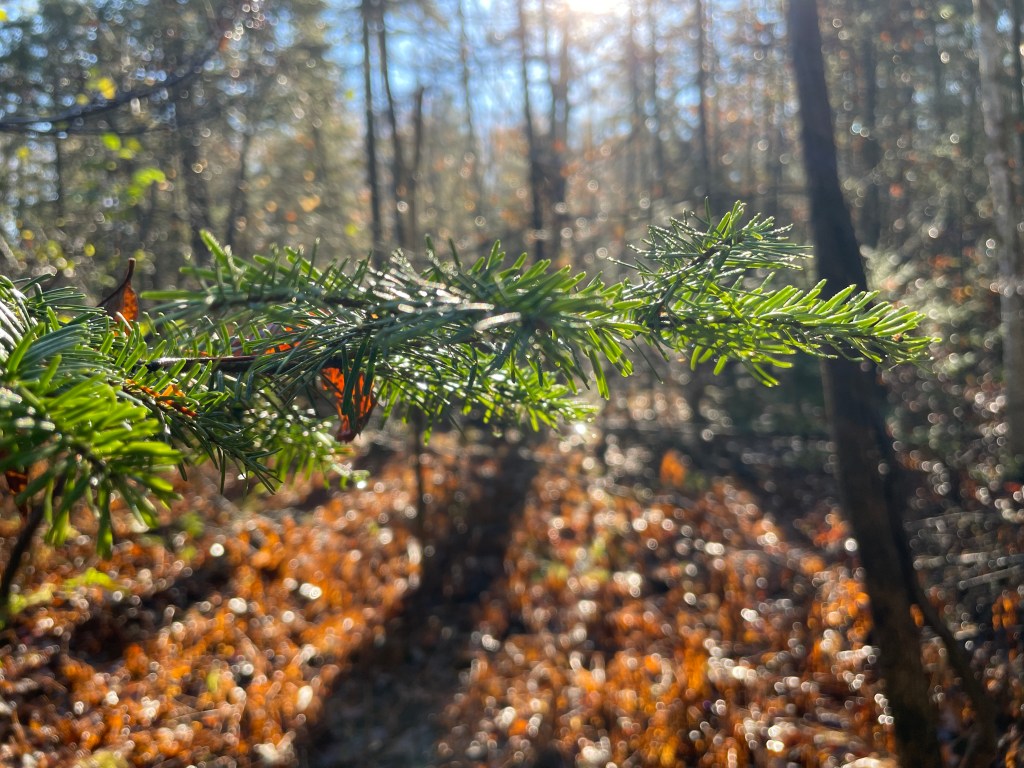
Yesterday, when I was walking in the woods after a couple days of rain, I saw a drop of water flashing on a pine bough, refracting sunlight and amplifying the blue hues in the sky or in the green needles it was clinging to. I don’t know how that works. Somehow, an azure nova had formed in my line of sight. It disappeared when I moved, reappeared when I tilted my head. It became clear light when I walked toward it. Then it was a drop of water, among many. And then it was a wet branch.
“Everything’s like that,” to quote a friend who says this whenever I present him with what I think is a novel idea. (Why, yes, he is trying to be infuriating.) Things look like one thing and then they look like another, depending on our perspective. We’re the blind men groping at a sliver of an elephant; we’re trying to gain some clarity by interpreting flickering shadows on the cave wall. There’s always another way to look at something, a piece of the puzzle under the table, an explanation for which we have no point of reference, a context within a context that could blow your mind if you tilted your head just so. Everything is like the gif that changes direction when you will it to with your mind.
I love the shift in perspective, the sudden new insight on some old problem. We’ve known since the beginning of time that there are infinite ways of looking at something, but it’s still like magic when the scales fall. When trying to work through something sticky, I hang on for that little flick to the head that will turn frustration into information, say, or fear into curiosity.
Two nights ago, I picked out a sleep meditation to listen to at bedtime. The meditation guide’s perspective on gravity was entirely new to me, but had such a ring of truth to it that I feel changed by it. I hadn’t thought much about gravity, but if I were to have described it last week, I might have referred to it as a weight, something to be defied, the opposite of freedom, the thing that makes our bodies sag, stoop, and fall down, an attitude of seriousness, somber and solemn. It’s why my knees hurt when I hike downhill. But this meditation guide talked about it as an embrace, something we can melt into. It is the feeling of being held close and supported by the earth. Gravity is our connection to home. It is belonging.
Since that night, I have been pausing periodically to feel the embrace of gravity, the way I might pause to revel in the sweetness of breathing. It’s such a simple shift in my perception of a concept that I never gave much thought to. But, the effect is like trying on the correct size garment after always having worn one that didn’t fit. I didn’t realize I had been uncomfortable until I got comfortable.
When I walk my dogs on the trails, I often fall down a tricky rabbit hole. It’s a mental drama in which some fellow hiker confronts me about whether I am cleaning up after my dogs. I then set fire to precious time coming up with ways to prove to this imaginary busybody that I am responsible. I will show them the bag of bags I carry! Yes, and what tone I should strike with them? Indignant? Bemused? Blasé? Would they be convinced? Would I be let go with a look that says, “OK, but we’re watching you.”? I feel quite high and mighty if I just happen to have a little bag of poop on hand that I can wield like a VIP pass before this self-appointed hall monitor of the hiking trail. “Well, what do you have to say about this!” I picture myself dangling it in the air between us.
It’s a spirit-diminishing reverie.
And it is a rotten and poisonous little fruit, the harvest of a lifetime of thinking there’s something wrong with me, that I don’t know what I’m supposed to be doing, and I don’t belong anywhere. It can pop up anywhere. Like at a store, where I wonder if someone will think I’m shoplifting. There’s an extra twisted and bitter one attached to this website. All the Tara Brach, Kristin Neff, and Brené Brown in the world is helpless before this florid case of imposter syndrome.
When I catch myself in this fugue state, I’ll try to make the shift into awareness, where I become a witness to this suffering I’m creating for myself. I’ll watch the brainworm unfurl, pay attention to how I react to it, notice how small it makes me feel. I ask why, in this absurd scenario, it feels so obvious to me that some fellow hiker would have the authority to see my papers, so to speak, and that I should debase myself to produce them for inspection. Why do I feel I should answer for my being here in a way that I don’t believe others should? Why do I concoct implausible scenarios that just scratch wounds into soft, new days?
I know the answer to that question. It’s a long and tedious one that lots of people know well: a childhood of not belonging and having that fact made mortifyingly plain by those who were responsible for me. Then, naturally, continuing to make it mortifyingly plain to myself when there was no one else there to do it for me. That must be what I’m doing on the hiking trail — telling myself a story about how someone could come along and let me know that they carry the authority of belonging and I do not.
The gurus of self-compassion would point out that I would never consider another child of god on this planet unworthy of taking up a little space in a public park. (And, though they wouldn’t put it quite like this, isn’t it massively egotistical to believe that I ALONE am unworthy? I mean, what a narcissist.)
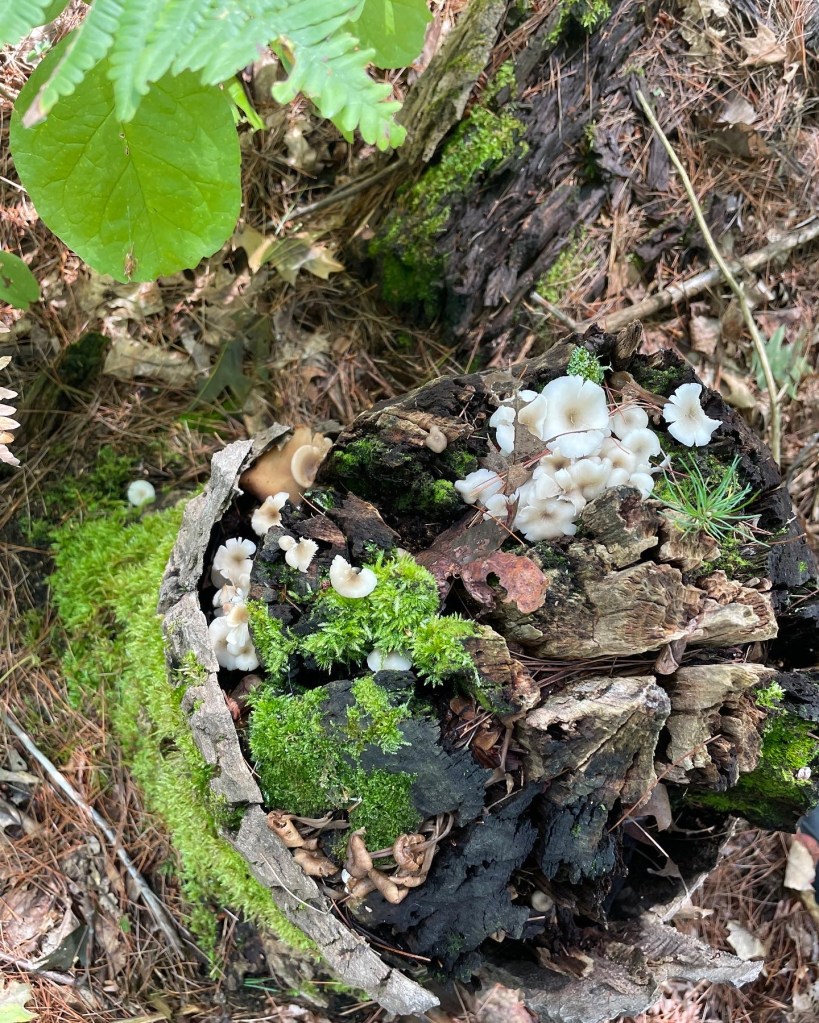
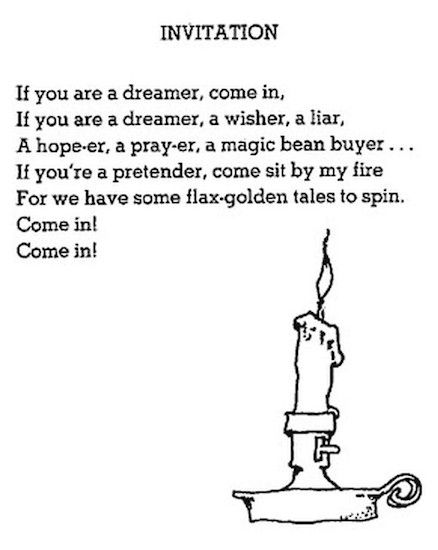
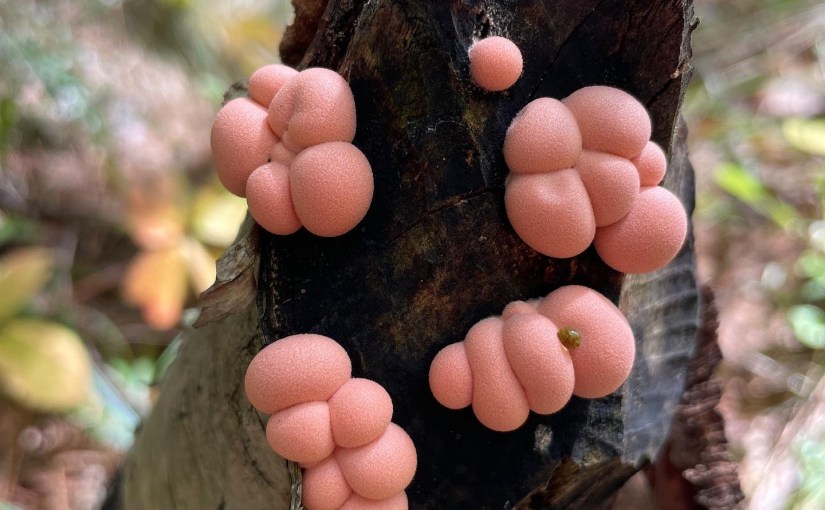
In recent weeks I have been gently prodding at how perhaps I could find some meaning in the sense that I am an interloper from no-man’s land. Could I learn to see that fruit as a kind of organic puzzle box, concealing the magical seeds of creativity and authenticity. The inkling was sparked when I shared a picture on Facebook that I had just taken on my daily hike. It’s of a decomposing stump, covered in mushrooms, with pine sapling growing out of it. I captioned it with something like “I wish Shel Silverstein had done a sequel to The Giving Tree.” The ensuing discussion with friends inspired me to revisit his work, which was so important to me when I was a kid. It was important because it was weird and ugly, and I felt weird and ugly. But it was exuberantly, joyfully weird and ugly, so that it was transcendent. It felt like the key to a place I wanted to get into.
That feeling his work gave me was so powerful when I was a child that, returning to it decades later, it swiftly breached the surface intact. Shel Silverstein had my rapt attention a lifetime ago, and now I get why. His work was fruit of the no mans land. It’s raggedy, but it’s sweet, somehow both wild and lovingly cultivated. He made it his. Meanwhile, in my no mans land, nothing is tended to. I sprinkled it with shame and longed to get out, so it has become overgrown with these bitter, mealy daydreams and self-debasing habits of mind.
I can feel the allure of allowing this insight to produce another mean little fruit, “You wasted your entire life; you squandered this gift, you dummy. You don’t have time to do anything with it, now that you’re old.” And, “Everyone already knows this, you know. Get your shit together.” The hook is seductive. I can’t remember which one of the gurus suggested this approach, but I will welcome this mean little fruit to come along with me, if it wants, as I turn around and walk back into the no mans land. But it’s going to have to bring up the rear, this time.
I’ve been getting the same message from different directions all week, especially today. The message is that you create meaning in your life with whatever ephemeral thing you are doing right now, be it ordinary or creative. In the few hours I’ve been awake, this message has creased my bean* 3 times.
On my morning hike, I was already thinking similarly. This is going to sound very prim, but I try to stay in the moment when I’m hiking. I don’t listen to podcasts or music and I try not to start puzzling anything out or making plans. If I find my mind in a rabbit hole, I recall it and tune back in to the woods, my breath, syncopating along the rocky path with two dogs on leash. There’s nothing noble or disciplined about my mindfulness practice in the woods. I just don’t want to miss anything. If I let my mind wander, autopilot takes control and the hike is over too quickly. Presence is a way of lingering. The point of walking into the woods isn’t to walk back out. I’m trying to dawdle.
One of my reveries today was about how my anxieties dissolve in the woods. General existential dread becomes a vapor when I move through this wild functioning ecosystem, where bright green mosses, mushrooms, slimes, and saplings colonize crumbling stumps and fallen logs. Bearing witness to interdependence, infinite connectedness on display in nature is like inhabiting the awareness of the wave that returns to the ocean. In the woods, you can’t see death without seeing life. Again, when exactly does an in-breath become and out-breath. Everything is perpetually unfolding and one thing is always rooted in something else. (Indeed, I get the irony of trying to be present in the woods and then tripping off into a mental fugue state about how awesome it is to be present in the woods.)
On my way back home, I listened to a podcast interview with a writer who pointed out that if you’re writing with the goal of making it to the top of the NYT best seller list — or engaging in any endeavor with a view toward the prize waiting for you in an imaginary future — it’s going to be a grasping, joyless process; it can never be enough.
And then, I picked up the internet and read this quote from Alan Watts: “If the universe is meaningless, so is the statement that it is so… The meaning and purpose of dancing is the dance.”
It reminds me of how my great old friend, Phil, sends postcards to people without including a return address. I received postcards from him for a year before I realized they were from him, because he didn’t write anything on them but my address. They were installments of a cosmic adventure comic he’d drawn, printed on card stock. He doesn’t know if his postcards are being received and doesn’t expect a reply. Sometimes, he’s not sure if he has the correct address for old friends. Still, he carefully matches the card to the recipient, or prints up photos he’s taken or artwork he’s created on card stock roughly postcard size, and (now) pens a message about what’s going on at the moment. His postcard habit just makes me giddy. I mean, how so authentically Phil and how goddamn delightful! Maybe this is also ironic, but I have a file in my cabinet where I save those meant for me of the little creations he sends far and wide. I use a couple for book marks.
* In Krazy Kat, Ignatz mouse is always maliciously throwing bricks at Krazy’s head, while Krazy, who is in love with Ignatz, chooses to interpret these bricks to the head as tokens of love and esteem. In Krazy’s dimension of Coconino County, being brained by a brick is at times referred to as having one’s bean creased. I don’t know why that phrase popped into my head as I wrote, but I just went with it.
I went to sleep last night thinking about that apple tree from the first post, and how a few days after I took that picture, I turned onto my road at the same time a woman on a bicycle was starting her journey down the trail. My road has 4 residents on it and turns into a nature trail, so it’s not well maintained by the city. It’s rough and you have to drive very slow. So I saw the whole thing: She noticed the little apple tree and stopped, straddled her bike, looked up, and began yanking down on a limb, apparently trying to drop an apple. And one did drop, fast, right on her head, right in front of me. (May that be the only time her helmet will be called on to do its job.)
I kept driving by, but I wanted to stop, get out of my car and have an intimate conversation with her about how much that sucked. It was a beautiful day and she had this vision of eating a wild apple from a rogue tree as she rode her bike down the nature trail around the lake, and instead she nearly knocked herself out in front of a stranger. Not only that, she had to pick the smashed apple up off the road and pretend she wanted it after it bounced off her helmet and hit the ground. When she bit into it a bit later, she surely discovered that it was bitter and wormy.
I wanted to say, omg I know! Why does exuberance and spontaneity always end in tears and shame. Why? When does it not? Never does it not. Never. You get this delicious idea in your head, and you can pretty much guarantee it will end up with you knocking yourself out with a macintosh in broad daylight in front of a stranger. We could have laughed together.
My wish is that she laughed her head off and has told the story a hundred times since, making all her friends laugh along with her. It could have been a fleeting apple, but instead it is an excellent story she can tell over and over again. I hope.
This apple has been sitting here alone on this unpublished website for a couple of months, with the word “test” underneath it. I just wanted a little placeholder content here so that I could try out different themes and agonize over what to say for myself. Well, apple, you are long gone — maybe picked by a passing bicyclist or relished by little worms — and I am just now getting around to bringing in a few words to keep your perfect avatar company.
I remember taking this picture. On my way home from a hike one late summer morning I drove past this lone, wild, rambley old apple tree that grows on the edge of the woods on the side of my road. It was so pretty and perfect, and I love to look at the funny space, the joint where the branch turns into the apple, the way I love to linger in the hanging space between an in-breath and an out-breath. When does one become the other? Is it only ever one thing at a time?




 Ilse Thompson